Posts

The Seven Deaths of Evelyn Hardcastle - Stuart Turton

Image
On the one hand, The Seven Deaths of Evelyn Hardcastle is a classic English country manor murder-mystery, but there’s a clue in the title that there’s perhaps a little more than this being a little different from the usual Agatha Christie pastiche. In as far as the murder-mystery question of who killed Evelyn Hardcastle at Blackheath manor, the usual suspects that can be found in a select group of notable society figures each with dark secrets are all in place. Explaining how Evelyn Hardcastle dies seven times however is a little more complicated. The fact that everything is not entirely what it seems is evident in the way that the reader is rather jarringly and unsettlingly thrown straight into a troubling and intriguing situation. Sebastian Bell finds himself inexplicably in the middle of the woods, screaming the name of a woman who appears to be being pursued by an attacker. He doesn’t know how he got there, and for a while can’t even remember his own name. It’s a bit like being ha...

From a Low and Quiet Sea - Donal Ryan

Image
Divided into four short parts, Donal Ryan’s From a Low and Quiet Sea appears to be a relatively simple and straightforward character study of three different people who we are led to believe will come together and connect in some way in the final part of the book. If that sounds like the novel is in reality three short stories that are tenuously linked together for the sake of novelistic purposes, in reality the technique actually captures something deeper about the nature of human experience, about life and the things that connect us all. The stories of Farouk, Lampy and John do however all appear to take place in complete isolation from one another. Certainly Farouk’s experience as a Syrian refugee is at least very different from the other two who live in the same part of the world around Limerick in Ireland, but the society and even the time period that Laurence (Lampy) and John don’t make it seem that they are likely to connect. Come together in a tragic situation they do however,...

Planetfall - Emma Newman

Image
It involves space travel to a distant habitable planet and a colony attempting to overcome the difficulties of creating a society on a new planet, so there are quite a few science-fiction areas of interest in Emma Newman’s Planetfall . For a while too there are several intriguing threads relating to the nature of the organic structure of God’s city that the travellers find on this strange world, as well as some guilty secrets, strange behaviour and unusual practices that seem to have developed in the short 22 year span that the new arrivals have spent on this new world. It’s soon apparent however that the SF elements are going to take second place to the exploration of human behaviour, which itself can be an interesting SF theme, but you are still left with a feeling that Planetfall has gone off course two-thirds of the way through. Certainly, the science that has permitted the Pathfinder Lee Suh-Mi and her team of acolytes to set out for some distant world is not particularly well de...

Elysium Fire - Alastair Reynolds

Image
I think I can see why Alastair Reynolds has decided to expand on his earlier novel The Prefect (repackaged as Aurora Rising ) and come around to the idea that there are more adventures to tell within the ranks of Panoply, the organisation responsible for monitoring the democratic process within the Glitter Band in the author’s Revelation Space universe. I’m not sure why I hadn’t noticed it before (perhaps because there’s less of a mass killer-robot distraction in this one), but the parallel of the role of the Prefects trying to uphold federalism and democracy within the Glitter Band becomes much more obvious in Elysium Fire when the question of “the will of the people” of a handful of worlds wanting to “take back control” through autonomy arises. To put it another way, it seems like there is going to be what you might call a ‘Glexit’ crisis. That however isn’t the main problem that the agents of Panoply have to deal with in this second Prefect Dreyfus novel, although as you’d imagine...

Asterix and the Chariot Race - Jean-Yves Ferri & Didier Conrad

Image
It was clear that the Asterix series was never going to be the same without its original creators René Goscinny and Albert Uderzo involved, although the series managed very well with Uderzo taking on both writing and drawing duties after Goscinny’s death in 1977. Since Uderzo retired in 2009, the series has continued with the new creative team of Jean-Yves Ferri and Didier Conrad, and to be honest, on a surface glance at Asterix and the Chariot Race (their third post-Uderzo title and the 37th title in the series) you’d scarcely notice the difference. Uderzo’s drawing style is replicated well, the characters retain their familiar characteristics, poses and mannerisms, and the plot is classic Asterix. There is nonetheless a nagging feeling that something is missing. The Roman-bashing Gauls are back in action then, but in Asterix and the Chariot Race  it’s not so much a one-sided magic potion-fuelled punch-up as a competitive race in the manner of Asterix and the Olympic Games  ...

Bloody January – Alan Parks

Image
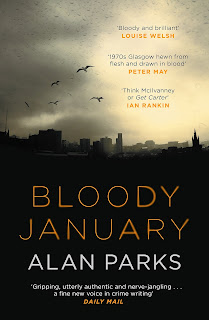
It doesn’t take too long to notice that Bloody January has all the classic ingredients and, most essentially, the style of a classic noir. The only real differences here is that we are walking down the mean streets of Glasgow and that the main detective isn’t a private one but one of dubious character in the Glasgow police force. Other than that, the character of corruption and moral decay is as plain as the mean streets, wasteland areas, damp housing schemes, dingy brothels, bleak drinking dens and dodgy nightclubs of a bloody January in the city in 1973. The nature of the characters that inhabit this moral wasteland and the situation that they find themselves in is also one familiar to fans of classic noir, but this is no pastiche; if it feels noir, then it’s the nature of the subject and Alan Parks’ debut is very much rooted in the its own time and place. In such an environment our lead detective Harry McCoy would of course be a heavy drinker, would be familiar with and no doubt sa...

Gnomon - Nick Harkaway

Image
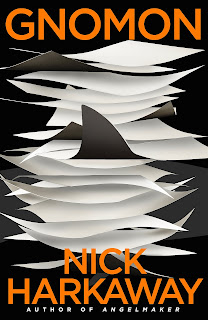
The ambitious concept, the format and the structure don’t immediately strike one as original, but sometimes it’s what you do with an idea that is important and there’s no reason why Nick Harkaway’s Gnomon can’t be better and more purposeful that some of the models it brings to mind. In the case of Gnomon , the obvious comparisons are works by David Mitchell, Christopher Nolan and – almost inevitably these days when you are dealing with high concept science-fiction – Philip K Dick. Gnomon is made up of a number of interconnected stories, exotic in nature, covering cast distances of space and time in the manner of Mitchell’s Ghostwritten or Cloud Atlas – and there’s a little bit of the computer game world and Orpheus mythology of Mitchell’s opera with Michel van der Aa, Sunken Garden . There’s an element of Christopher Nolan’s Inception in that those identities are overlaid, imported into the mind and ‘lived’ in a mental dream-state, adopting a persona from a scanned memory, and the...