Posts

Showing posts with the label Historical fiction

Deception - Alan Parks

Image
Alan Parks' first crime thriller Bloody January started out inspired by a real life incident and extended into a much wider view of criminality (and associated social deprivation) in his Harry McCoy series set in Glasgow in the 70s. It looks like true historical events connected to the bombing raids on Glasgow during WWII were also the inspiration for Park's Gunner , the first book in his Joseph Gunner series. Inevitably, with Deception coming as the second book in the series, that world is also going to be similarly expanded; and it is - just not in the way I might have expected. It's no great surprise that a second Gunner book has surfaced while Parks takes a sabbatical mid-way through his Harry McCoy series (much as I was hoping for a quicker return to the 70s Glasgow police thriller), as it clearly had the potential to be a series and the sub heading 'A Joseph Gunner Thriller' suggested as much. What is a surprise however is that in Deception Parks has locat...

The Whisper of Stars - Cristin Williams

Image
The Whisper of Stars is an ambitious work of fantasy fiction that lays its fantasy elements onto real-life history and even real-life historical figures. That's not entirely new of course, but what is impressive is in how convincing Cristin Williams makes it, building a folk-like legend around a particularly dark moment in world history without making light of the horrors surrounding it. The events of the novel are set in 1923 in the aftermath of the Russian Revolution, where the Bolshevik forces under Lenin are hoping to use the skills of a select group of citizens to serve the needs of the state: those with the ability of witchcraft. There are three individuals in particular in the novel with striking and different abilities. Yekaterina Efremova, comes from a family of anarchists, Katya the daughter of the famous Svetlana Efremova. Katya is volshevniki , born with magic powers, her speciality as a charovniki is in the casting of spells. After some experiments to try to control ...

The Death of Shame - Ambrose Parry

Image
In any good continuing series there are often some unresolved matters, some with the potential to be time-bombs that could go off at any time. There has been a few such open threads left throughout Ambrose Parry's Raven and Fisher series, mostly in the romantic tension between Raven and Fisher which has been complicated by their differing backgrounds, personalities and their experiences in the medical profession. Since this is set in Victorian Edinburgh, those experiences would have been markedly different for a man and a woman. And then there is the fact that, in the three year gap between the events of The Way of All Flesh and The Art of Dying , both got married to other people.  It's fair to say however - in keeping with the general tone of the series as a whole - neither of those marriages were conventional and certainly didn't resolve the feelings that they had for each other. As we reach what is expected to be the final episode in the five part series, time is runni...

Gunner - Alan Parks

Image
Alan Parks has left his Glasgow detective Harry McCoy at his lowest point midway through the series in To Die in June . He's in a really bad place, the cumulative effects of his profession, the declining state of Glasgow to gangsters, drug dealers and all kinds of social problems in the 1970s. Combined with an alcohol problem, family and personal difficulties, it's not looking too good for Parks' detective. But while we wait for McCoy to pull himself out of a very dark hole, the author turns the clock back and turns his attention to Glasgow in an earlier period during the WWII bombing raids on the city and its shipyards where, frankly, it wasn't exactly a paradise then either. Nor is Joe Gunner in any better state than McCoy. Just returned from Dunkirk, partly shell shocked, leg and face ripped apart by shrapnel, he is met at St. Enoch train station by his old chief Drummond. Nether of them should be police officers, but due to the war Drummond has been pulled out of re...

Carta bianca - Carlo Lucarelli

Image
The first novel in Carlo Lucarelli's Commissioner De Luca series is set during a very significant period, and it's undoubtedly something that contributes to its particular mood and character, or perhaps I should say that Lucarelli succeeds in establishing that particular character of a police murder investigation that takes place in April 1945, in the dying days of the war that precipitate the fall of Mussolini's Republic of Salò. It's not a political thriller, even if many of the characters are of necessity connected to the government, but it's also more than just background colour, the period and the politics making any murder investigation that involves an official just that little more difficult and dangerous. Indeed Carta bianca opers with commissioner De Luca finding himself having to duck as a grenade attack carried out on a funeral procession as he makes his way to a crime scene. Only recently transferred to political police headquarters of the Questore in R...

The Cautious Traveller’s Guide to the Wastelands - Sarah Brooks

Image
Before you even start it, you can tell that The Cautious Traveller's Guide to the Wastelands is going to take you to strange places. The title alone is promising enough, but the basic outline premise is even more intriguing. It involves a long train journey from Beijing to Moscow in 1899, the service provided by the the Trans-Siberia Company. It's back up and running again, reportedly stronger than ever after the mysterious circumstances of the last journey across the stricken Wastelands that caused the crew and passengers to lose their memory of the journey. As you are introduced to the passengers however, you soon begin however to wonder where the real danger is; whether it will come from the blight that has made the land outside uninhabitable and still carries strange sickness or whether it will come from the odd assembly of passengers on board, each taking the journey for private reasons, some clearly for different reasons than those they make public to the others. There i...

Gli scorpioni del deserto - Hugo Pratt

Image
Inevitably, considering Hugo Pratt's travels, living and working around the world, his collection of war stories written between 1969 and 1992 for Gli scorpioni del deserto (The Scorpions of the Desert) are far from typical. Actually, there's nothing inevitable about it of course, as the plotting, motivations of the characters and the wide perspective from all sides of the international conflicts are far from what is commonly found in wartime adventures and exploits. It's a measure of how great an artist Pratt is that even as an Italian national, his view of his home country's operations in North Africa is seen from the perspective of the allied forces and not from what we might expect as a tolerant or excusable view of ordinary Italian soldiers caught up in the conflict, but even the 'enemy' are given a fair hearing. Such an approach is not unlike those found in the adventures of his most famous character Corto Maltese then, and similar characteristics can be...

Las tres bodas de Manolita - Almudena Grandes

Image
The start of this decade has been tough on Spanish literature with the premature deaths of at least two notable writers. The death of Javier Marías in 2022 was certainly noted in the UK, but not so much Almudena Grandes who died less than a year earlier of cancer at the age of 61. That's perhaps understandable as few of her works have been translated into English, but she was a major figure in Spain and particularly associated with her home city of Madrid. As writers, the two were very different in style and content, Marías certainly the more literary of the two, but Grandes had her own important part to play in the chronicling of lives in her works. No more so than in her final series of novels, Episodios de una guerra interminable (Episodes from an interminable war), works all centred on a painful subject kept under a veil of silence that few had tackled directly; the horrors of the Civil War and the lasting impact of the Franco years.  My experience of reading Almudena Grandes t...

Corto Maltese: l'integrale, Volume 1 - Hugo Pratt

Image
La Giovinezza (1981) I wasn't keen on opening the Corto Maltese l'integrale complete Italian language Corto Maltese collection with a later work as it's far from Hugo Pratt's best work, but chronologically I suppose it belongs at the start. A short introduction by Corto relates how he was a friend of Jack London in Manchuria during the 1904/1905 Russo-Japanese war and it was there that he first encountered Rasputin, who makes his 'first appearance' with a series of typically senseless killings. The war is nearing an end, but one of the Siberian regiment is not ready to put down his arms. Rasputin is introduced immediately as ruthless and challenging of authority not out of principle but it's in his nature. He intends to join up with other like minded rebels and head for the coast, but since he doesn't make himself likeable to the Japanese either - nor indeed anyone - he doesn't get too far. The famous adventure writer Jack London however makes arran...

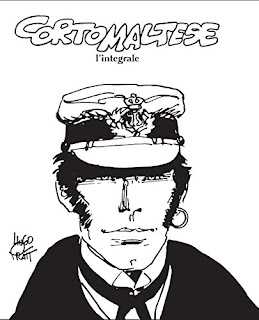
Corto Maltese: l'integrale - Hugo Pratt

Image
I've read and admired Hugo Pratt's work on the Corto Maltese series for a long time recognising it as one of the greatest creations of comic art. Unfortunately, English editions have been randomly produced over the years, with little sense of continuity and variations in quality, and quickly go out of print. Some have been colourised with approval of Pratt, but even some black and white editions in an effort to make them more accessible have been reformated for pocket editions, cropping artwork and frames. None of this has taken away greatly from the brilliance of Hugo Pratt's artwork and creation, but I always felt like I wasn't getting the full experience. Having only previously read a few Dylan Dog adventures in Italian while on holiday, I sampled a few of the Italian eBook editions of Corto Maltese: ( Vudù per il Presidente ,  Concerto in O' minore per arpa e nitroglierina ,  Le Elevetiche Rosa Alchemica   to see how readable they were, and found that with aid...

Voices of the Dead - Ambrose Parry

Image
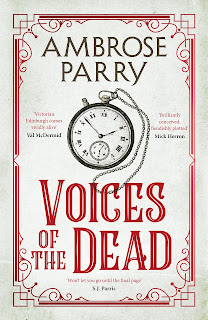
The appearance of Voices of the Dead is a welcome addition to Ambrose Parry's Edinburgh Victorian period medical crime drama series (now collectively known as the Raven and Fisher mysteries, extending it successfully beyond the first three excellent books. There is no shortage of period crime thriller series, but there is obviously something special about this one in the way that it makes use of historical progress and development in science and medicine around this period that contributes to its unique perspective. All the more so since Edinburgh and Dr. Simpson are at the centre of those important advances; advances that not only benefit the general public - and even Queen Victoria, who helped give legitimacy to the use of chloroform to ease the burden of childbirth - but those advances also contribute to the investigation of crime. Medicine and crime are a good match, but it also means a good match in the husband and wife team of Christopher Brookmyre and Marisa Haetzman, who ...

Zoonomia - Bessora

Image
"Vos les ancêtres, m'avait dit Michée en me conduisant à mon arbre le soir de ma Mort, vous êtes des empêcheurs d'avenir." Zoonomia is the first volume of a proposed tetraology, La Dynastie des boiteux (The Dynasty of the Lame), already followed by Citizen Narcisse , the proposed Black Almanach (which appears to have been renamed as Vos les ancêtres , just published in France) and Le Livre de Michée (The Book of Micah), each a saga of a family line in a different period, inspired by real historical figures. Johann, the main figure of Zoonomia is based on Paul Bellini Du Chaillu, Franco-American explorer, adventurer and naturalist born in Réunion in 1831. The first book at least inhabits in places the same hallucinatory history of the world, race and colonialism as Steve Erickson ( Arc d'X ) or the Vorrh trilogy of Brian Catling. Not following any linear line across the tetraology, Zoonomia opens in 1846 with 15-year-old Johann, an illegitimate half-caste yo...

Corto Maltese: Concerto in O' minore per arpa e nitroglierina - Hugo Pratt

Image
We usually know where Corto Maltese stands in terms of political allegiances, which is less to do with ideology than being in the side of the ordinary people against oppression, on the anti imperialist and anti-colonialist side of any conflict - but more often he remains romantically more than ideologically involved. That's the case when in Concerto in O' minore per arpa e nitroglierina he arrives in Ireland in 1917 just after the Easter Uprising to find trouble on the streets of Dublin. Soldiers patrolling in 'autoblindos' armoured cars come under attack from a group of IRA operatives led by Banshee O'Dannan. Corto's first objective is not to get involved in the struggle, but to visit the grave of the recently deceased Pat Finnucan. When he is asked what is is looking for, he replies in his usual wry manner ' La pentola d'oro del lepricano ' (The leprechaun's pot of gold). Finnucan had been the leader of Sinn Féin, hoping to take the revolution...