Posts

Showing posts with the label Haruki Murakami

Killing Commendatore - Haruki Murakami

Image
Killing Commandatore starts in a typically Murakami way, the narrator, mid-thirties, an artist or painter at least, being asked to paint the portrait of a man with no face, just a whirl of fog. Is it real, a dream or a metaphor? With Murakami it can be all of these and something more, and more than ever Murakami seems to be retreating into a narrow field where he is writing about writing, or in the case of Killing Commendatore , writing about ideas and metaphors quite openly and literally as Ideas and Metaphors. Initially at least however, Killing Commendatore gets off to an intriguing start. The narrator has been painting portraits in Tokyo to make a living. He’s good at it, able to quickly sketch a likeness and even imbue his work with some of the personality of his sitter. When he breaks up with his wife however he goes off-grid, settling in a house on top of a remote mountain, rented out by a friend, the son of a Japanese painter of some renown, Tomohiko Amada, who is now confine...

Wind / Pinball - Haruki Murakami

Image
Although English translations of Haruki Murakami's two earliest short novels have been made available in now rare Japanese editions, these new approved translations of Hear the Wind Sing  and Pinball, 1973  are the first time the works have been published in the UK and USA. Despite the author never previously wanting the books to be made officially made available outside of Japan, both early novels are good examples of Murakami's distinctive voice, a voice that is admittedly more obvious in Japanese, but clearly something must come through in the English translations as well. The author muses on how this 'voice' was developed in the introduction to Wind / Pinball . Having worked as a translator for a while (an occupation that is important to Pinball, 1973 ), Murakami hit on a style of writing his books in English first and then 'translating' them into Japanese. The distinct rhythm of this style does come through, and is obviously what is important to a translato...

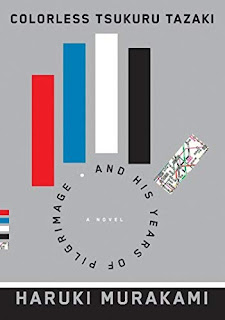
Colorless Tsukuru Tazaki and his Years of Pilgrimage - Haruki Murakami

Image
Love it or hate it, Colorless Tsukuru Tazaki is on the Norwegian Wood side of Haruki Murakami's writing, dealing with personality issues and difficult relationships, but it still has the author's familiar diversions into surrealism, magic realism, post-modernism or whatever you want to call the dream-like flights of imagination and strange connections that his sensitive characters establish with the world around them. At the heart of Colorless Tsukuru Tazaki is a typically sensitive young man, a misfit with emotional problems who struggles with relationships. It wasn't always that way, Tazaki once an equal part of a close-knit group of five friends in Nagoya. Murakami's unique outlook on the dynamic of the group is interesting, each of the two boys and two girls having a name that refers to a colour, while Tazaki is "colourless". And in some ways that reflect how TT sees himself. When Tazaki leaves to go to university in Tokyo, he finds himself inexplicably...