Posts

Showing posts with the label Georges Simenon

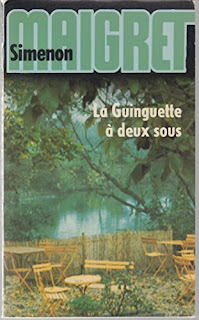
La guinguette à deux sous - Georges Simenon
Image
Following up an obscure lead left to him by a criminal about to be executed, Maigret discovers a hidden side to a group of Parisians of respectable professions, and becomes a witness to what they get up to in their leisure time. At the weekends, these respectable gentlemen - engineers, businessmen, shop owners, doctors - and their wives, all make their way to a tavern on an outlying location on the Seine known as the Guinguette à deux sous, where they indulge in dressing up, role-playing, heavy drinking, fine eating, and a little bit of fishing and canoeing. Extramarital affairs are also indulged during the partying, often with the tacit consent of all the couples involved. Such matters are not of great concern to Maigret and not why he is at the Guinguette à deux sous when he should be on holiday in the country with his wife. He's been told by the criminal to be executed, Lenoir, that there is a murderer among the group who was seen six years ago dropping a body into the canal Sai...

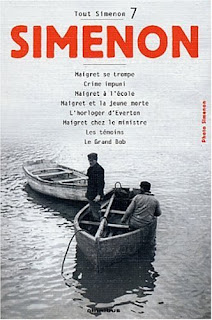
Les témoins - Georges Simenon

Image
It's not unusual for characters in Simenon's novels to be deeply flawed individuals, suffering from alcoholism, conducting illicit affairs, and emotionally estranged from their partners, but although many such cases end up before Lhomond, the Presiding Judge at a Paris Law Court, the judge himself would until recently have considered himself beyond any such reproach. He works assiduously late into the evening and looks after his ailing wife, but one night when leaving a disreputable local bar that he has entered in order to make a phone-call to the doctor for his wife, he is seen by the prosecution lawyer on a murder case he is working on, and feels that the innocent act may have given the wrong impression. That impression is not helped by Lhomond coming down with the flu, looking under the weather the next morning and smelling of alcohol from a quick shot of brandy taken to ease the symptoms. The judge realises the figure he must present, but knows he is helpless to correct th...

Maigret chez le Ministre - Georges Simenon

Image
As the title suggests, this Maigret investigation is rather more high-profile than the usual crime cases that the P.J. have to deal with on a regular basis, cases that an unruffled and unhurried Maigret resolves with a few enquiries interspersed with a few drinks at the bar.Indeed, Maigret is initially perturbed when phoned at home by the Auguste Point, Minister of Public Works, and reluctant to become involved in a serious political scandal that also has the Sûreté breathing down his neck. He has every reason to be concerned, since the Minister has had an important document stolen, a confidential report on the affair of the faulty construction of a mountain Health Centre that resulted in the death of over a hundred children. Only recently uncovered and handed over to the Minister for it to then disappear, the scandal has the potential to seriously embarrass some senior public figures, if not bring down the current government. Nonetheless, despite the complications and uncertainty of t...

L’horloger d’Everton - Georges Simenon

Image
Set in smalltown USA and written while Simenon was living there, L'horloger d'Everton nevertheless has all the familiar characteristics of Simenon's unique approach to the crime novel.  The central crime incident takes place "off-screen", when Ben, the 16 year-old son of watch repair man Dave Galloway disappears with a car, a gun and the 15 year-old daughter of his neighbour and soon becomes a fugitive from the law. Simenon's focus however is on the factors underlying Ben's out of character behaviour, examining the background of Dave Galloway family background, his own broken marriage and his relationship with his son, and as well as the monotony and watchfulness of the small community in which they live and their own peculiar form of rebellion against social and bourgeois expectations. If it doesn't reveal anything significant or different from other Simenon novels with a similar subject matter, the novel's American setting brings in another in a...

Maigret et la jeune morte - Georges Simenon

Image
In a seemingly a rather straightforward procedural, Maigret investigates the death of an unknown woman found beaten to death and left in a public square in Montmartre.  The actual procedural, the results of the autopsy, the reporting of the incident in the newspapers, the following up on leads, the interviewing of people who all knew the woman but did not know her well and did not for various reasons come forward, all make the revelations about the mysterious woman intriguing, but Simenon makes it much more than this. Maigret’s investigation runs in parallel with another dour and indefatigable inspector known as Malgracieux, who through sheer persistence and old-school methods always seems to be one step ahead of Maigret - right up until the final revelations.  There it’s Maigret’s experience and his ability to put himself in the place of the victim (here as often a young person who has come to the big city from the country like Maigret) and his sense of intuition that show th...

Maigret à l’école - Georges Simenon

Image
When a man turns up in his office, anticipating arrest for the murder of an old lady, Maigret travels to a little village in the provinces in a non-professional capacity. Shot through the eye by an air-pistol while looking out her window, the villagers aren’t exactly sorry that the old woman is dead – she’s been the terror of the village for years – but if someone has to pay for the crime, they reckon it might as well be the school teacher, since he’s considered an outsider. Simenon’s in familiar territory here – Les Fiancailles de Monsieur Hire , L’Assassin –convincingly depicting the workings of small communities, watching each other through windows, gossiping, ostracising outsiders, creating a sense of community only through mutual fear, guilt and suspicion. Coming from a small country village himself, Maigret is only too familiar with this kind of behaviour, and slips quietly back into their way of thinking to uncover the underlying motivations of the killer.

L’homme au petit chien - Georges Simenon

Image
Written in the form of a journal, L’homme au petit chien is a rather reflective meditation by a man who has lost everything in his life. This type of story can often be rather dull and depressing with Simenon ( Les anneaux de Bicetre or Le grand Bob for example), but there is an intriguing crime element that is gradually revealed in L’homme au petit chien . Felix Allard lives alone with his dog, and has been working for the past eight years in a small bookstore. Terminally ill and contemplating suicide, his condition doesn’t escape the notice of the shop’s owner. Allard however isn’t going to die until he has recounted in his journal the events that took his wife, his children and a successful career from him. Behind the cold, reflective tone and outlook, there is the story of a crime passionnel .