Posts

Showing posts with the label Drama

When We Dead Awaken - Henrik Ibsen

Image
When We Dead Awaken (1899), Ibsen’s final play and “Dramatic Epilogue”, is one of a series of reflective works on the nature of the artist, his work and the price that must be paid for it. Professor Rubek is a sculptor who, disillusioned by the reception to his masterpiece - The Resurrection Day - which he believes no-one has truly understood, has abandoned his art for meaningless commercial work. His disillusionment with his work and its reception has however come at some cost to his humanity and at the expense of the people around him. At a mountain spa, the professor’s aloofness consequently causes a certain bitterness, restlessness and detachment to creep into his marriage to Maia. The distance between them is measured in two other figures who “haunt” the spa. One is a woman, Irene, an old acquaintance who inspired Rubek’s masterpiece. She believes that her soul has been destroyed since her time with the professor - she blames the professor for sucking the life out of her for his ...

John Gabriel Borkman - Henrik Ibsen

Image
The subject of John Gabriel Borkman (1896) makes it seem like a companion piece to Ibsen's earlier dramas The Pillars of Society or Enemy of the People , dealing with the subject of corruption, or at least an act of guilt in the past on the part of an individual that is to have a profound effect on the wider community, but viewed here in aftermath. As one of Ibsen’s latter plays, the subtext of John Gabriel Borkman however is that of an act of corruption by an artist, who has forsaken the truth and love for more material gains, a theme that is borne out by Ibsen’s next and final drama, When We Dead Awaken (1899), where the subject is made more explicit. In the case of John Gabriel Borkman , the figure at the centre of the intrigue is a disgraced bank manager who has served five years in prison for financial irregularities that brought about the collapse of the bank and the savings of many people in the community. Borkman has served a further three years locked in the upstairs a...

A Month In The Country - Ivan Turgenev

Image
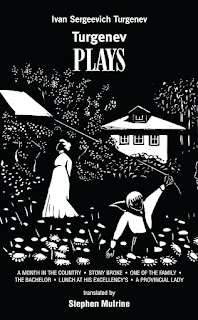
Prefiguring Chekhov’s theatre work, Turgenev in dramatic form can perhaps seem to lack the precision and beauty of his prose work. On the page, A Month In The Country seems to offer little more than the romantic complications of Russian ladies and gentlemen in a setting isolated from the rest of the world with little in the way of any defining national or social characteristics, but its openness necessarily allows much more to be drawn from it in a stage setting. Despite the lack of any real drama - the romantic entanglements are almost entirely verbal, the complications and realisations agonised over in soliloquies - structurally the drama and the interaction between the various players of differing ages and classes is purposefully and powerfully achieved, reaching a conclusion of complete devastation of almost everyone involved without anything actually seeming to have occurred.