Posts

Mauricio o las Elecciones Primarias - Eduardo Mendoza

Image
Eduardo Mendoza's regular novels can seem quite mundane in comparison to the delights of his witty and entertaining comedies, but there is always something compelling in his characters lives and their struggles with personal dilemmas that holds the reader's attention. Set in Mendoza's hometown of Barcelona, a chance meeting with an old school friend Fontán gives Mauricio the chance to enliven his rather routine solitary life as a dentist by becoming involved in local politics. When his half-hearted political career as a candidate for the socialist party doesn't take off, he goes back and puts his efforts into improving his dentistry career. His encounter with Fontán and his brief flirtation with local politics however bring two women into his life - Clotilde, a young woman who lives with her parents and is underemployed and undervalued at a lawyer's office, and la Porritos an unemployed woman living in deprived conditions who he meets playing guitar and singing at p...

Asterix and the Roman Agent - Goscinny & Uderzo

Image
In an attempt to undermine relations in the indomitable Gaulish village, Caesar sends out an agent who has an uncanny ability to sow discord wherever he goes. In no time at all he has the combative inhabitants at each other’s throats. Classic Asterix tale, this makes good use of the colourful characters in the village, and even has a landmark battle where all four Roman camps join forces in battle against a village without magic potion, and practice their own form of “psychological warfare”. Even the pirates get in on the act. Marvellous.

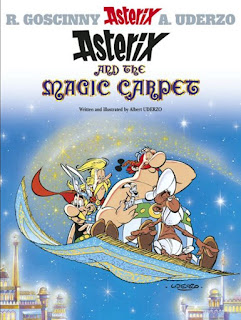
Asterix and the Magic Carpet - Albert Uderzo

Image
Good, but not classic post-Goscinny Asterix. Uderzo tells a nice visual story and the script - in the English version - is well adapted with all the usual terrible puns, but little that is really inspired. The Arabian Nights in India story is fine, we get the usual fun with the pirates and there's a nice cameo by Julius Caesar, but really you miss the big punch-ups with the Romans.

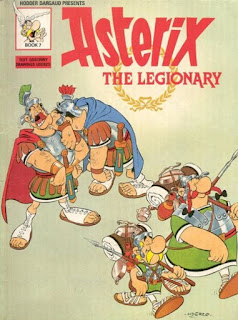
Asterix the Legionary - Goscinny & Uderzo

Image
One of the very best Asterix stories, all the way back from 1967, Asterix The Legionary is strong in every department – a purposeful story, superb drawings, marvellous secondary characters and - since the boys have joined the Roman Legion in their attempt to bring back the boyfriend of Panacea, who has been recruited – there are plenty of Romans to both bash and endless frustrate. The script and names are wittily translated, as ever, into English and there are good running jokes throughout – one at the expense of a hieroglyphic-speaking Egyptian unwittingly conscripted into the army believing the barracks is a hotel, the other around characters constantly breaking down into tears.  Needless to say, the journey gives the boys an opportunity to get reacquainted with their old friends the pirates on the way to Rome and again on the return journey.

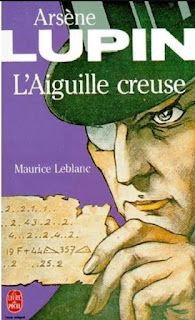
Arsène Lupin, L’aiguille creuse - Maurice Leblanc

Image
What starts out seemingly as a regular attempted burglary gone wrong soon turns into something much larger when it is discovered that the ringleader shot by one of the family is none other than Arsène Lupin.  The mystery of his activities in the house and the location of his dead body are revealed by an ingenious young student called Beautrelet (modelled very much on Gaston Leroux’s Rouletabille), but the discovery of a coded paper referring to the L’aiguille creuse (the hollow needle) suggests an even greater mystery. Lupin of course isn’t dead, and the mystery deepens as Beautrelet sets off around France on the trail of the master criminal in an attempt to uncover one of the greatest secrets of the French Royal family. Through kidnappings, abductions, impersonations and threats of dire consequences, Lupin manages to stay one step ahead of the young investigator, the chief of police and even Herlock Sholmès in an always thrilling, and ultimately tragic adventure.

Maigret à l’école - Georges Simenon

Image
When a man turns up in his office, anticipating arrest for the murder of an old lady, Maigret travels to a little village in the provinces in a non-professional capacity. Shot through the eye by an air-pistol while looking out her window, the villagers aren’t exactly sorry that the old woman is dead – she’s been the terror of the village for years – but if someone has to pay for the crime, they reckon it might as well be the school teacher, since he’s considered an outsider. Simenon’s in familiar territory here – Les Fiancailles de Monsieur Hire , L’Assassin –convincingly depicting the workings of small communities, watching each other through windows, gossiping, ostracising outsiders, creating a sense of community only through mutual fear, guilt and suspicion. Coming from a small country village himself, Maigret is only too familiar with this kind of behaviour, and slips quietly back into their way of thinking to uncover the underlying motivations of the killer.

L’homme au petit chien - Georges Simenon

Image
Written in the form of a journal, L’homme au petit chien is a rather reflective meditation by a man who has lost everything in his life. This type of story can often be rather dull and depressing with Simenon ( Les anneaux de Bicetre or Le grand Bob for example), but there is an intriguing crime element that is gradually revealed in L’homme au petit chien . Felix Allard lives alone with his dog, and has been working for the past eight years in a small bookstore. Terminally ill and contemplating suicide, his condition doesn’t escape the notice of the shop’s owner. Allard however isn’t going to die until he has recounted in his journal the events that took his wife, his children and a successful career from him. Behind the cold, reflective tone and outlook, there is the story of a crime passionnel .